Tuesday, July 7, 2015
Rejoice!
This past weekend in Canso, Nova Scotia was the 19th annual StanFest, a music festival in memory of Stan Rogers, the great Canadian singer-songwriter. Perusing the festival guide brought back by a friend, I observed that Steeleye Span was one of the featured acts on Saturday night. I remember listening to Steeleye Span back in the late 1970s, but I could not remember the songs, so I looked some up on Youtube. I was delighted to find that one of the group's recordings was of an old Christmas tune called Gaudete. The Latin verb gaudeo, gaudere, gavisus sum means I rejoice, and gaudete is the imperative plural form meaning "Rejoice!" Let's observe a little Christmas in July, because the Latin lyrics are so clear. Enjoy!

Thursday, July 2, 2015
Driving Romanian Cars
In the Wheels section of today's Halifax Chronicle Herald, an article about cars made in Romania under the brand Dacia made me smile. The Romans under Trajan in the early years of the second century A.D. beat the Dacians, who lived in the area to the west of the Black Sea, thereby making the Roman Empire as great as it would be. The Romans called this area, around the modern country of Romania, Dacia. Before Dacia became a Roman province, the first emperor Augustus exiled the poet Publius Ovidius Naso (Ovid) to Tomi on the shore of the Black Sea. Today Ovidiu is a town in Romania, near the area where Ovid died in exile. There's lots of history on the roads in Romania.
Wednesday, June 24, 2015
Dryathon
I noticed in a rest stop along the road, driving from New York state to Nova Scotia, Canada, a paper-towel dispenser with the brand name Marathon. Many know this word as the twenty-six-(or so)-mile foot race, and many also know the origin of this word in a place name in ancient Greece, a plain about twenty-six miles from Athens, whose name means “fennel field.” According to legend (and the Dictionary of World Biography, vol. 1 by Frank Northern Magill, Taylor & Francis, 1998), on this plain in 490 BC, Greek forces under the Athenian general Miltiades beat a Persian army; a runner named Philippides (or Pheidippides) ran the twenty-six or so miles to Athens to deliver the news, and then died, possibly because this same runner had earlier run one hundred and forty miles both to Sparta to ask the Spartans for help and then back to Marathon. Today in English marathon can also be used as an adjective to mean “great, large, lasting a long time or involving a lot of effort.” Marathon seems like a good name for a paper-towel dispenser that can be used twenty-four hours a day at a highway visitor center or rest stop, every day of the year.
P.S. Also -athon or -thon has become a noun-forming suffix in English words like telethon, radiothon, phonathon, dance-athon, events that extend over hours or days to raise money for charitable causes using television, radio, telephones, or dancing.
Monday, June 15, 2015
What's In A Name?
I cannot stop marveling at the bottomless well that is the ancient world for supplying names to the most modern space-craft. Philae is in the news as a space-craft that has woken up after landing on a comet! Read more about naming Philae and its landing space.
Happy Birthday, Magna Carta!
Today, 15 June 2015, is the eight-hundredth anniversary of the signing by King John of Magna Carta, the Great Charter, or as I used to tell my sixth-graders, the Big Paper. Magnus, a, um is the Latin word for “great, big, large,” and charta, ae f. means “papyrus, paper, map, chart, charter, writing.” In my local library I found a little, wonderful book, 1215 The Year of Magna Carta by Danny Danziger and John Gillingham (Touchstone, 2004). At the end of the introduction the authors describe a visit to Runnymede they made on a dark December day when they had finished writing their book. They describe two memorials at Runnymede. How many Americans know that one acre of Runnymede is American territory, donated by the Queen and her government, by vote of the House of Commons? That in this acre are two memorials, one to President John F. Kennedy and one built by the American Bar Association, both dedicated to the ideal of liberty under law as symbolized by Magna Carta?
Here, as given by Danziger and Gillingham, are the two most famous of the sixty-three clauses of Magna Carta:
Nullus liber homo capiatur, vel imprisonetur, aut disseisiatur, aut utlagetur, aut exuletur, aut aliquo modo destruatur, nec super eum ibimus, nec super eum mittemus, nisi per legal judicium parium suorum vel per legem terre.
Nulli vendemus, nulli negabimus aut differemus rectum aut justiciam.
"No free man shall be taken or imprisoned or deprived or outlawed or exiled or in any way ruined, nor will we go or send against him, except by the lawful judgement of his peers or by the law of the land.
To no one will we sell, to no one will we deny or delay right or justice." (p. xii-xiii)
The Latin of the Great Charter is beautiful and clear; a few words influenced by English and French are present (disseisiatur, utlagetur, legal, terre, justiciam), but otherwise any student of Latin recognizes the future active and passive verbs, nouns, adjectives, conjunctions, and prepositions that Cicero, Caesar, and Vergil would also know.
How excellent that this splendid anniversary falls between Flag Day and Fourth of July!

Sunday, June 14, 2015
Flag This Day
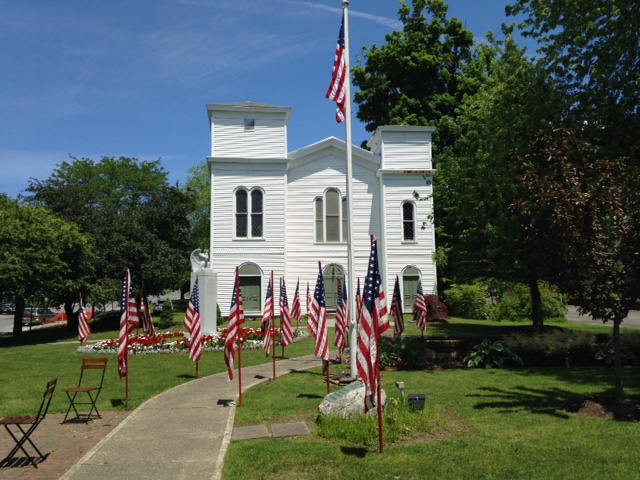
Today, 14 June 2015, is Flag Day, a day when Americans display the flag and observe the birthday of the American flag. Here is what downtown Millerton, NY looked like just after noon.
What do Americans do on Flag Day?
Flag Day falls within National Flag Week, a time when Americans reflect on the foundations of the nation’s freedom. The flag of the United States represents freedom and has been an enduring symbol of the country’s ideals since its early days. During both events, Americans also remember their loyalty to the nation, reaffirm their belief in liberty and justice, and observe the nation’s unity.
Celebrating national unity—what an excellent idea, especially in these next few weeks leading to America’s birthday, celebrated on the Fourth of July.
Here's another shot of a view up Main Street:

Long may she wave, o'er the land of the free and the home of the brave.
P.S. Where is the Latin connection? On the Flag Day website I noticed a small error; one of the links is called & Etcetera. The Latin phrase et cetera already means "and other (things)," so no "& (and)" is necessary. The symbol & is called an ampersand.
Wednesday, June 10, 2015
Juno in Jewelry
I've been de-cluttering. This afternoon I found a jewelry advertisement I saved from a local newspaper about a year ago. I spied a brand in very tiny letters called Juno Lucina, a producer of gifts for mothers, appropriately named, for the Roman goddess of women and childbirth is Juno. As protector of women in childbirth, she is called Juno Lucina. Towards the back of the advertising insert, I also noticed a brand of men's rings called Triton. In Greco-Roman mythology Triton was a god of the sea, a son of Poseidon/Neptune, half man, half fish. I admire the Triton jewelry logo; it turns a T into a trident, the traditional symbol of gods of the sea. Latin lives on in jewelry boxes everywhere.
Subscribe to:
Posts (Atom)